
For years, grinder materials followed a predictable formula.
Metal was considered serious. Plastic was affordable. Wood was unusual.
That distinction is beginning to feel dated.
Across lifestyle design, natural materials, visible grain and warm woods continue to have a strong presence. Even 2026 interior trends are leaning toward warm woods, earthy materials and pieces that feel individual rather than perfectly uniform.
Cannabis accessories are moving in a similar direction. Contemporary brands are creating grinders, trays, pipes and storage pieces that look more like designed household objects than disposable accessories.
Within that shift, the wood weed grinder suddenly makes much more sense.
Especially when it is made from something more interesting than ordinary generic timber.
Exotic hardwood is not one single look
“Wooden” can be a frustratingly broad description.
Two woods can differ dramatically in grain, tone, density and visual personality.
That diversity is exactly what makes exotic hardwood interesting for a small object such as a grinder.
Take three examples from Woodie’s collection.
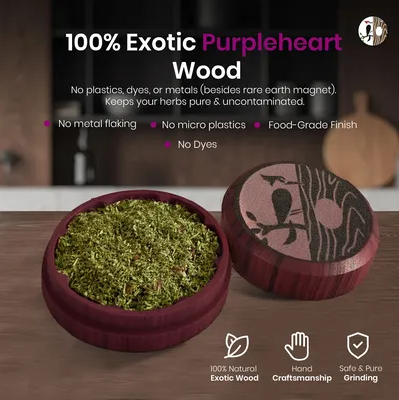
The Tigers Eye is produced from Canary wood, which naturally carries combinations of yellow, brown, tan and darker markings. Jasper uses Bloodwood, known for much deeper crimson coloration. Amethyst is made from Purpleheart, giving it a naturally distinctive purple character.
No coating needs to pretend that those materials are different.
They already are.
Natural grain creates genuine variation
Industrial manufacturing normally tries to eliminate variation.
Every black grinder should resemble every other black grinder.
Wood works differently.
Grain can move through two pieces cut from the same species in completely different patterns. Color can shift. Lines can appear heavier in one grinder and quieter in another.
That means a genuine hardwood grinder will never be perfectly identical to the next one.
Woodie specifically highlights this one-of-one quality as part of its approach: the grain pattern, coloration and texture come from the material itself.
For mass production, inconsistency can be considered a defect.
For natural materials, it is often exactly what people want.
The teeth matter as much as the exterior
There is an important difference between a wooden grinder and a grinder decorated with wood.
Some products use a wooden outer layer while retaining a conventional internal grinding mechanism.
There is nothing inherently wrong with that approach, but buyers specifically looking for a natural construction should look deeper.
Woodie’s exotic grinders machine the diamond-shaped teeth directly into solid hardwood. Apart from the coated magnet used for closure, the design avoids making a decorative wooden shell around ordinary metal grinding surfaces.
That creates a more coherent object.
Wood outside.
Wood inside.
The material is functional rather than ornamental.
CNC machining and hand finishing can work together
“Handcrafted” and “precision manufactured” are sometimes presented as opposites.
They do not need to be.
Modern woodworking can use digital machining to create repeatable dimensions and then rely on human finishing to bring out the character of the material.
That combination is particularly appropriate for a grinder.
The geometry needs to be accurate enough to operate smoothly. At the same time, the final surface should feel like finished wood rather than something pulled directly from a machine.
Woodie’s process follows that model. Its hardwood grinders are CNC machined and then individually hand finished with food-grade oils and waxes.
It is an interesting middle ground between mass manufacturing and traditional woodcraft.
Why a two-piece design suits wood
Complexity tends to dominate accessory marketing.
More chambers.
More screens.
More moving sections.
Wood invites a different philosophy.
A straightforward two-piece structure gives the material room to become the focus. It also avoids turning a simple object into a collection of threaded sections.
Woodie’s wood weed grinder collection follows that minimalist approach.
For someone accustomed to four-piece aluminum grinders, it can initially appear almost too simple.
That is part of the point.
Wood changes with you
Natural materials ask for a little care.
You should not treat a wooden grinder exactly like stainless steel.
Woodie advises avoiding excessive water and heat. For its exterior, a small amount of beeswax or hemp oil can be applied when needed to bring back the wood’s natural luster.
That may sound less convenient than dropping a metal object into a cleaning solution.
But people who enjoy wooden cutting boards, furniture, instruments or other handcrafted objects often understand the appeal.
Maintenance becomes part of ownership.
The material develops character rather than simply becoming scratched.
A different definition of premium
Premium used to mean polished metal, extra weight and additional components.
That definition is becoming broader.
Premium can also mean material selection.
- It can mean a grain pattern that cannot be duplicated.
- It can mean removing unnecessary pieces instead of adding them.
- It can mean combining machine precision with hand finishing.
That is what makes exotic hardwood such an interesting direction for grinder design in 2026.
The wood weed grinder is not trying to win a competition for the most chambers or the most mechanical-looking construction.
Its appeal comes from somewhere else.
Canary wood does not look like Bloodwood.
Bloodwood does not feel visually interchangeable with Purpleheart.
And one piece of Purpleheart will never reproduce the grain of another perfectly.
For people surrounded by products engineered to look identical, that individuality has real value.
The grinder remains a practical object. It just no longer has to look ordinary.